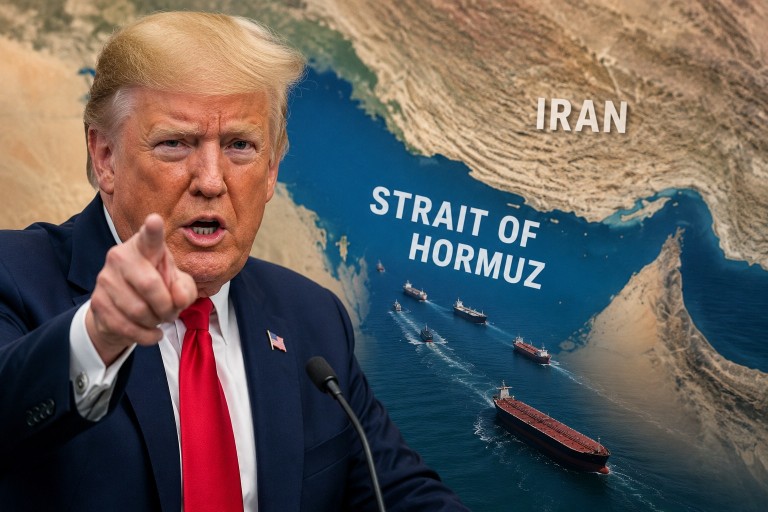
In a startling declaration, US President Donald Trump has hinted at the possibility of the United States claiming the Strait of Hormuz as its territory, amid ongoing tensions with Iran. Speaking in New York, Trump suggested that following a victory over Iran, the US might soon assert control over this critical maritime passage, which he argued is already under effective US blockade. The Strait of Hormuz is a vital artery for global oil transportation, with approximately 20% of the world’s seaborne oil crossing its waters, located between Iran and Oman.
The potential claim over the strait has not been formalized into a change of US policy, leaving analysts to ponder whether Trump’s remarks were more rhetorical than actionable. Meanwhile, Iran has swiftly dismissed the threat, with Deputy Foreign Minister Kazem Gharibabadi emphasizing that the decision to open or close the strait rests solely with Tehran. Iranian Foreign Minister Abbas Araqchi further stated that there has been no decision to re-engage in negotiations with the US, despite intermediary communications via Qatar and Pakistan, which he clarified do not equate to formal talks.
Iran has laid out a series of demands before it considers reopening the strait to regular shipping traffic, including the lifting of sanctions, compensation for damages incurred during wartime, and the release of its frozen assets. The closure and ongoing conflict have significantly disrupted shipping activities, leading to a surge in fuel prices worldwide, exerting pressure on consumers. President Trump justified the increased fuel costs, arguing that the price Americans are paying is a necessary measure to prevent Iran from developing nuclear weapons.
The stalemate over the Strait of Hormuz has sparked global concern regarding energy security and the broader economic repercussions of the conflict. As discussions remain stalled, the international community watches closely, wary of the potential for further escalation and its possible impact on global markets.