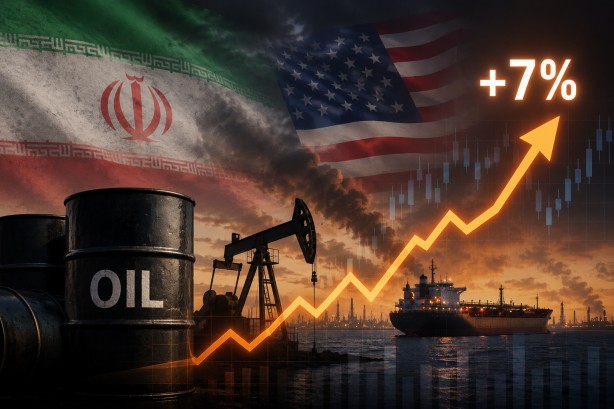
Oil prices saw a significant increase, climbing over 7%, amid escalating military tensions involving Iran, the United States, and Saudi Arabia. Concerns about possible disruptions to global energy supply chains drove Brent crude prices up by nearly 8%, reaching around $90.75 per barrel, while West Texas Intermediate (WTI) experienced a rise of almost 7%, hitting approximately $84.76 per barrel. The surge in prices followed a series of military engagements that have sparked fears of a prolonged conflict in the region.
The recent spike in tensions arose when Iran’s Islamic Revolutionary Guard Corps (IRGC) claimed responsibility for launching ballistic missiles at U.S. military facilities located in Jordan, citing retaliation against recent American military activities. In response, coordinated strikes by U.S. and Saudi forces targeted Iran-backed militant locations in Iraq. These operations were described as efforts to dismantle logistics and weapons networks tied to repeated drone attacks on military and energy infrastructures.
The ongoing conflict has also heightened concerns about maritime security. The IRGC reported that its naval forces intercepted and attacked three oil tankers in the Strait of Hormuz, accusing them of ignoring navigation warnings. Adding to the complexity, Yemen’s Houthi rebels announced they had targeted a Saudi-linked oil tanker in the Red Sea, further escalating risks for commercial shipping in the region.
This renewed instability raises fears of potential supply disruptions through the Strait of Hormuz and the Bab el-Mandeb Strait, both critical corridors for global energy transit. Market analysts have warned that the continuation of attacks on shipping and energy infrastructures could sustain elevated oil prices and contribute to increased volatility in global markets.